
It's not your decision
The second face of power

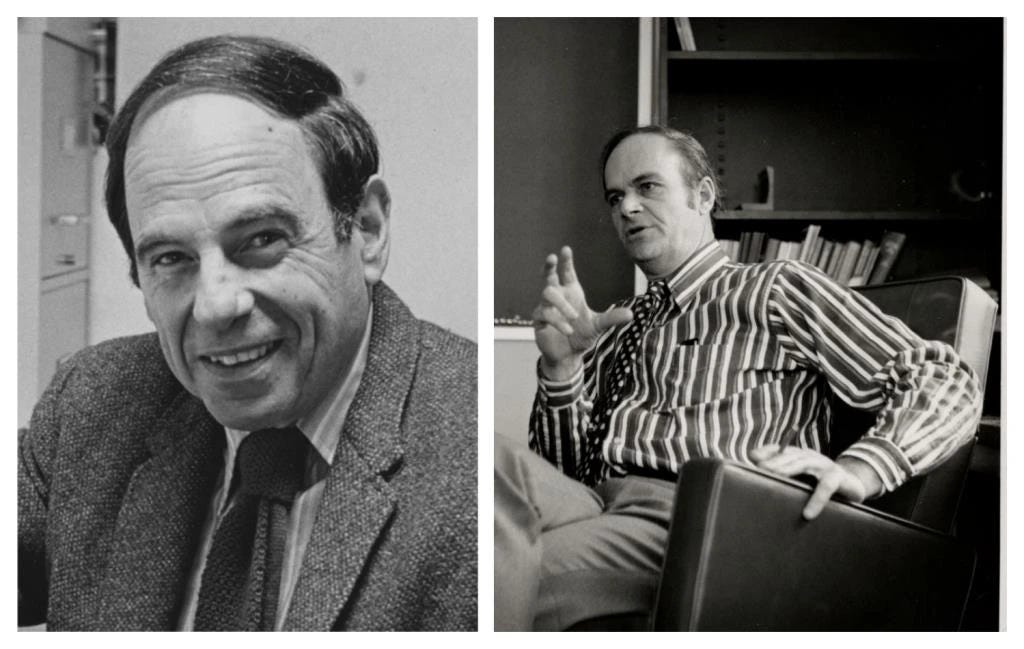
There are “two faces of power”, according to the 1970 book Power and Poverty written by American neo-Marxist academics Morton Baratz and Peter Bachrach.
The first face is what we would commonly think of as power: “Of course power is exercised when A participates in the making of decisions that affect B.”
The other face of power, the second face, is more discreet, more covert:
Power is also exercised when A devotes his energies to creating or reinforcing social and political values and institutional practices that limit the scope of the political process to public consideration of only those issues which are comparatively innocuous to A. To the extent that A succeeds in doing this, B is prevented, for all practical purposes, from bringing to the fore any issues that might in their resolution be seriously detrimental to A’s set of preferences.
This second face of power was demonstrated in what Baratz and Bachrach termed ‘nondecision-making’. That is, “the practice of limiting the scope of actual decision-making to ‘safe’ issues by manipulating the dominant community values, myths, and political institutions and procedures”:
… nondecision-making is a means by which demands for change in the existing allocation of benefits and privileges in the community can be suffocated before they are even voiced; or kept covert; or killed before they gain access to the relevant decision-making arena; or, failing all these things, maimed or destroyed in the decision-implementing stage of the policy process.
This nondecision-making can take several forms.
The first, the most direct and extreme, is the use of force to prevent demands for change. That may include things like, for example, arresting a pregnant woman in her home for creating a social media post protesting against government policy.
Second is the exercise of power, which is just as direct but less extreme. The use of power can be negative (punishing those who seek change) or positive (rewarding those who don’t ask for change). It ranges from outright intimidation (overt threats) to cooptation (“hey, you asked for this!”). Intimidation could include things like “denial of bank credit, dismissal from employment, revocation of draft deferment, etc.” (How prescient).
Cooptation occurs when “the activities of non-elites in decision-making and policy implementation are channeled toward the pre-conceived goals of higher authorities.” Participatory democracy is a “particularly potent form of cooptation”, because it “gives the illusion of voice without the voice itself.” One might think here of Prime Minister Anthony Albanese’s statement, after securing barely one-third of the primary vote in 2025, that the promises he took to the election were “not the limits of our responsibilities or our vision.”1
The third form of nondecision-making is invoking an existing bias of the political system, “a norm, precedent, rule or procedure”, to squelch issues. “For example, a demand for change may be denied legitimacy by being branded… unpatriotic, immoral, or in violation of an established rule or procedure.” When ordinary Australians participated in protests against mass migration in 2025, for example, the Multicultural Affairs Minister, Anne Aly, said that they were “clearly racist”. The taxpayer-funded ABC published an article claiming that these protesters – made up of an ethnically diverse group, including many migrants – were part of a “re-emergent white nationalism” with a “Hitler-glorifying agenda”.
As an additional part of this third form, challenges can be “deflected by referring the demands or issues to committees or commissions for detailed and prolonged study or by steering them through time-consuming and ritualistic routines that are built into the political system.” When the Albanese government, and then the broader political class, came under intense public scrutiny for the millions of dollars they were billing taxpayers to fly their families around the country, politicians hid behind “the rules” (which they of course “did not write”). They then deferred the issue, commissioning advice from the Independent Parliamentary Expenses Authority, and then referring it to the independent Commonwealth Remuneration Tribunal. The political heat was taken out of the issue, and essentially nothing changed.
The fourth form, the most indirect one, “involves reshaping or strengthening the mobilisation of bias in order to block challenges to the prevailing allocation of values.” Providing funding to academics, NGOs, and other organisations to uphold and promote the status quo, for example. An entire private sector bureaucracy has been built upon this premise, ensuring that there is an army of technically non-government stakeholders willing to uphold the status quo and challenge any narratives before they become popular and present a challenge.
It would, of course, take university academics to come up with an intellectual framework to describe something that mainstream Australians know and articulate plainly: “they don’t allow us to have a say.” But that does not mean it isn’t useful. The framework of nondecision-making provided by Baratz and Bachrach helps us analyse what has gone wrong with Australia’s political system.
The examples given here of nondecision-making are just a selection; dozens could be given for each form. And it should be no surprise that as these techniques have been deployed more readily and across a broader range of desired political debates, Australians have expressed increasing dissatisfaction with the political system.
Australians have been searching for a new avenue to express their views for some time. The share of the primary vote going collectively to the Labor, Liberal and National parties was relatively constant between the 1950s and the late 1980s at around the 90 percent mark. Since then, however, it has declined significantly, reaching a new low of 66.4 percent at the 2025 election. Meanwhile, between 1967 and 2025 the share of voters stating that they have no political partisanship has risen from 11 percent to 25 percent, with the bulk of this increase coming after 2010.
The opportunity is ripe for a third force, for a new (or highly reformed) political party that rejects this kind of elitist exercise of the second face of power, and which is willing to speak for the mainstream.
As the Australian jurist and law professor W. Jethro Brown wrote in 1899: A decision of “the majority”, achieved through preferential voting, “like the philosopher’s stone, turns everything to gold; once secured it justifies anything - past, present, or future.”
I don't think this is right. I think that actually it is the first kind of power that is being wielded here. The examples you list are for the most part power wielded by political leaders through the executive enabled by the legislature and judiciary.
Defining the "second face of power" as
> dominant community values, myths, and political institutions and procedures
These clearly belong to the populist-nationalist-conservative right in this country. Our dominant community values are clearly incompatible with the multiculturalism being pushed. Our great national myths are wars fought against foreigners in defence of a White Australia. Our political institutions and procedures maintained a White Australia up until a single generation ago!
I don't know your politics, the above may be unpalatable to you - I'm only using it as an extreme example. But it's important to be clear that it is the first definition of power that we are up against. Marxists need to rally against community values, national myths, and political institutions for a reason - we do not.
We could completely pause the decline through a single branch of government, or a select few centres of power. It could be completely reversed in less than a decade without even requiring constitutional changes. The future of Australia is our decision.
Problem here is, there are NOT too many bright 'people' coming out of ANY university these days, make no mistake about that. A new and, third party is ultimately required, and, NOW. Always remember this, 'The good thing about really intelligent 'people' is, they are not very bright'.